Chairman, Standing Committee on Finance and Revenue
Friday, 25th September, 2026
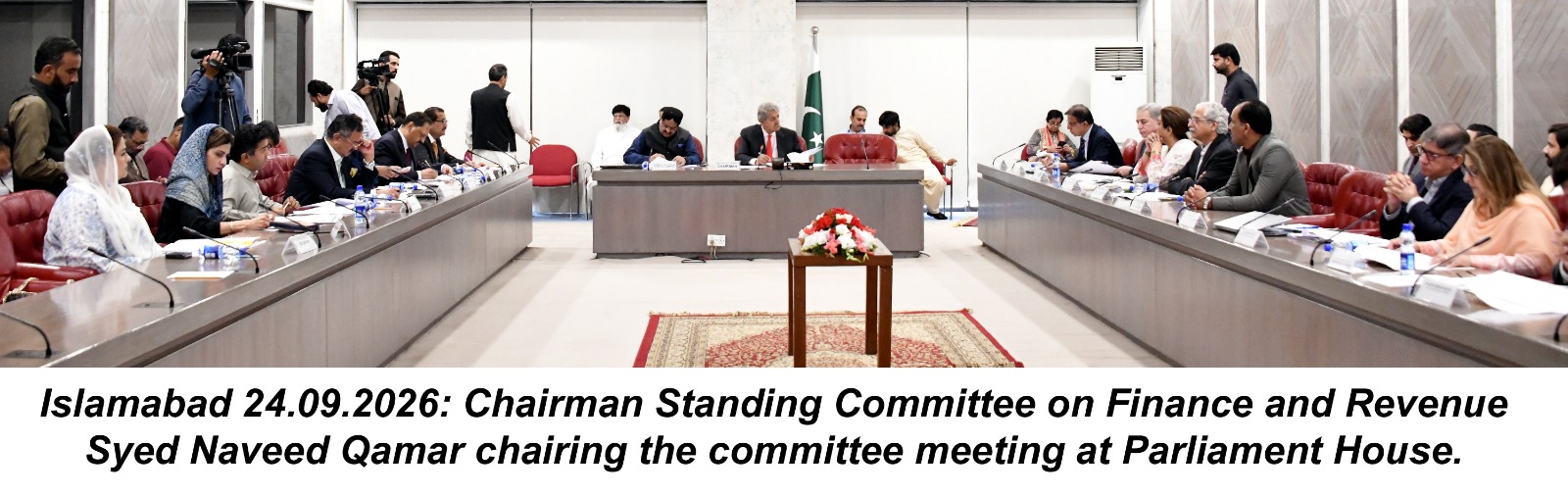
Islamabad, : Hon. Syed Naveed Qamar, Chairman, Standing Committee on Finance and Revenue, emphasized that economic reforms must be underpinned by a coherent, transparent and sustainable economic strategy, particularly where their implementation could impose additional costs on consumers, businesses and productive sectors of the economy. He stressed that fiscal consolidation should be accompanied by measures aimed at promoting investment, exports, employment and sustainable economic growth.
He was chairing a meeting of the Standing Committee on Finance and Revenue, which held an extensive review of the implementation of Pakistan’s Extended Fund Facility (EFF) Programme with the International Monetary Fund (IMF). The discussion focused on Programme conditionalities, fiscal consolidation, revenue mobilization, structural reforms, energy-sector measures, climate commitments, privatization initiatives and their implications for the economy and the general public.
The Committee undertook a detailed review of the ongoing EFF Programme and associated reform commitments, covering implementation of Programme benchmarks, fiscal consolidation, revenue mobilization, energy-sector reforms, provincial commitments, governance of State-Owned Enterprises (SOEs), climate-related measures, privatization initiatives and public-sector austerity.
Members emphasized that assessment of the IMF Programme should not remain confined to formal compliance with prescribed benchmarks, but should also determine whether the reforms were translating into measurable economic and social outcomes. The Committee sought clearer information regarding implementation timelines, outstanding commitments, effectiveness of public expenditure and the implications of various reforms for citizens, businesses and taxpayers.
The Secretary, Finance Division, briefed the Committee that the EFF Programme was approved on , with a total Programme size of US$7 billion. Cumulative disbursements were reported at approximately US$4.5 billion, while three Programme reviews had been completed. The Programme was described as supporting balance-of-payments needs and macroeconomic stability, while requiring reforms relating to revenue mobilization, debt sustainability, fiscal consolidation, taxation, the energy sector, SOE governance and trade liberalization.
The Committee was informed that key Programme commitments included parliamentary consideration of supplementary expenditure beyond approved budgets, restrictions on new tax amnesties and preferential tax treatment, energy-sector reforms and implementation of the National Fiscal Pact with the provinces.
The Committee also examined primary-surplus targets, government guarantees and the fiscal position of the provinces. Members questioned how provincial surpluses and expenditure priorities were being reconciled with the overall fiscal framework. Officials highlighted commitments relating to human-capital development, social protection and minimum expenditure levels for health and education.
The Chair stressed the importance of outcome-based reporting, particularly in the social sectors, and sought information demonstrating what health and education expenditures had actually achieved, rather than merely reporting the quantum of expenditure incurred.
The Committee examined the retailer tax-registration scheme in detail. Members questioned the limited initial participation and sought a measurable assessment of its effectiveness. The Committee called for an assessment covering the number of registrations, revenue generated, compliance outcomes and whether the existing design of the scheme required further adjustment.
The Committee emphasized that the Finance Ministry should assess the performance of the scheme over a defined period and hold the implementing authorities accountable against clearly stated objectives. The role of the Federal Board of Revenue (FBR) in implementation was also discussed, and further briefing on the matter was sought.
Members sought detailed data regarding industrial captive-power users that had shifted to the national grid and requested clarification regarding the resulting implications for gas and petroleum consumption and circular debt. The Committee emphasized that the implementation of energy-sector reforms should be assessed against their actual operational, financial and economic outcomes.
The Committee reviewed the governance framework for State-Owned Enterprises and the reporting relationship between government-owned entities, their respective line ministries and the Finance Division. Officials stated that reporting lines had been clarified and that proposed amendments were aimed at strengthening boards, improving governance and enhancing investment discipline within the Sovereign Wealth Fund framework.
Members sought clearer information regarding statutory entities requiring alignment with the SOE Act, as well as the legislative amendments currently under consideration.
The Committee received an update on the proposed privatization of Distribution Companies (DISCOs). Officials reported that three entities were at an advanced stage, with international investor interest and pre-qualified parties participating in the process.
Members, however, sought greater transparency regarding the proposed transaction structure, particularly whether the transactions would involve outright privatization, management transfer or concession arrangements. The Committee also sought clarification regarding the treatment of assets and liabilities and requested a written presentation setting out the proposed terms and conditions before the process proceeds further. Officials informed the Committee that valuations had been undertaken and that potential bidders had been provided access to relevant information.
The Committee also examined the restructuring and proposed transaction involving Pakistan International Airlines (PIA). Officials referred to a net asset position of approximately Rs9 billion following restructuring and explained that the Government was considering a transaction involving 75 percent ownership.
Members sought a clearer and comprehensive numerical presentation covering valuation, liabilities, transaction proceeds and the position of the remaining government shareholding. The Committee stressed that financial information relating to the transaction should be presented in a professional, transparent and easily comprehensible format to enable Members to properly assess the proposed transaction.
The Committee reviewed the Resilience and Sustainability Facility (RSF), including pending reforms and disbursement-linked measures. Members sought clarification regarding the seven reforms reported as unmet and questioned whether delays in implementation could result in additional costs for consumers, including through carbon-related measures.
The Finance Secretary briefed the Committee on reforms relating to climate screening of public investment, climate tagging in budgetary documents, disaster-risk financing, climate-related financial-risk management for banks and incentives for the private sector to develop electric-vehicle charging infrastructure.
The Committee questioned whether formal completion of a policy benchmark necessarily reflected effective implementation on the ground. Particular attention was given to electric-vehicle charging infrastructure, with Members seeking evidence of actual physical progress and functioning facilities rather than merely administrative completion of the relevant policy measures.
The Committee emphasized that any viability-gap funding or other incentives intended to support private investment should be based on measurable implementation, open bidding processes and transparent eligibility criteria.
The Committee also reviewed public-sector austerity measures, including a temporary 50 percent reduction in fuel provision for official vehicles, subject to specified operational exemptions, as well as a 5 percent reduction in the non-ERE budget for FY2026–27, estimated at approximately Rs16.1 billion.
Members sought evidence of actual savings resulting from these measures and questioned whether the austerity initiatives were yielding substantive fiscal benefits. The broader discussion underscored the need to link fiscal discipline with measurable savings, improved expenditure efficiency and demonstrable fiscal outcomes.
In concluding the discussion, the Committee emphasized the need for consolidated and outcome-oriented reporting on outstanding IMF benchmarks, province-wise expenditure outcomes, revenue mobilisation measures, energy-sector reforms, privatization structures, RSF commitments and austerity savings.
The Committee further stressed that future briefings should provide clear implementation timelines, measurable performance indicators and comprehensive written financial information to facilitate effective parliamentary oversight and enable Members to assess not only compliance with programme commitments but also their tangible economic and social impact.
The Committee expressed its displeasure over the absence of the Chairman, Securities and Exchange Commission of Pakistan (SECP), as well as the inadequate presentation made by the representatives of the SECP and the Privatization Commission on the agenda items relating to the CSR Bill, 2026 and PIA Holding Company Limited (PIAHCL). The Committee, therefore, deferred consideration of the said agenda items for discussion in its next meeting.
The Committee confirmed the minutes of its previous meeting.
The meeting was attended by Rana Iradat Sharif Khan, Ms. Zeb Jaffar, Dr. Nafisa Shah, Ms. Hina Rabbani Khar, Dr. Sharmila Faruqui, Dr. Mirza Ikhtiar Baig, Mr. Muhammad Javed Hanif Khan, Mr. Arshad Abdullah Vohra, and Ms. Shahida Begum, MNAs. The meeting was also attended by the Secretary Finance, and senior officials from the Finance Division, the FBR, SECP, Privatization Commission and other relevant Ministries and Divisions.

 Print
Print