Standing Committee on Poverty Alleviation and Social Safety meets
Monday, 31st August, 2026
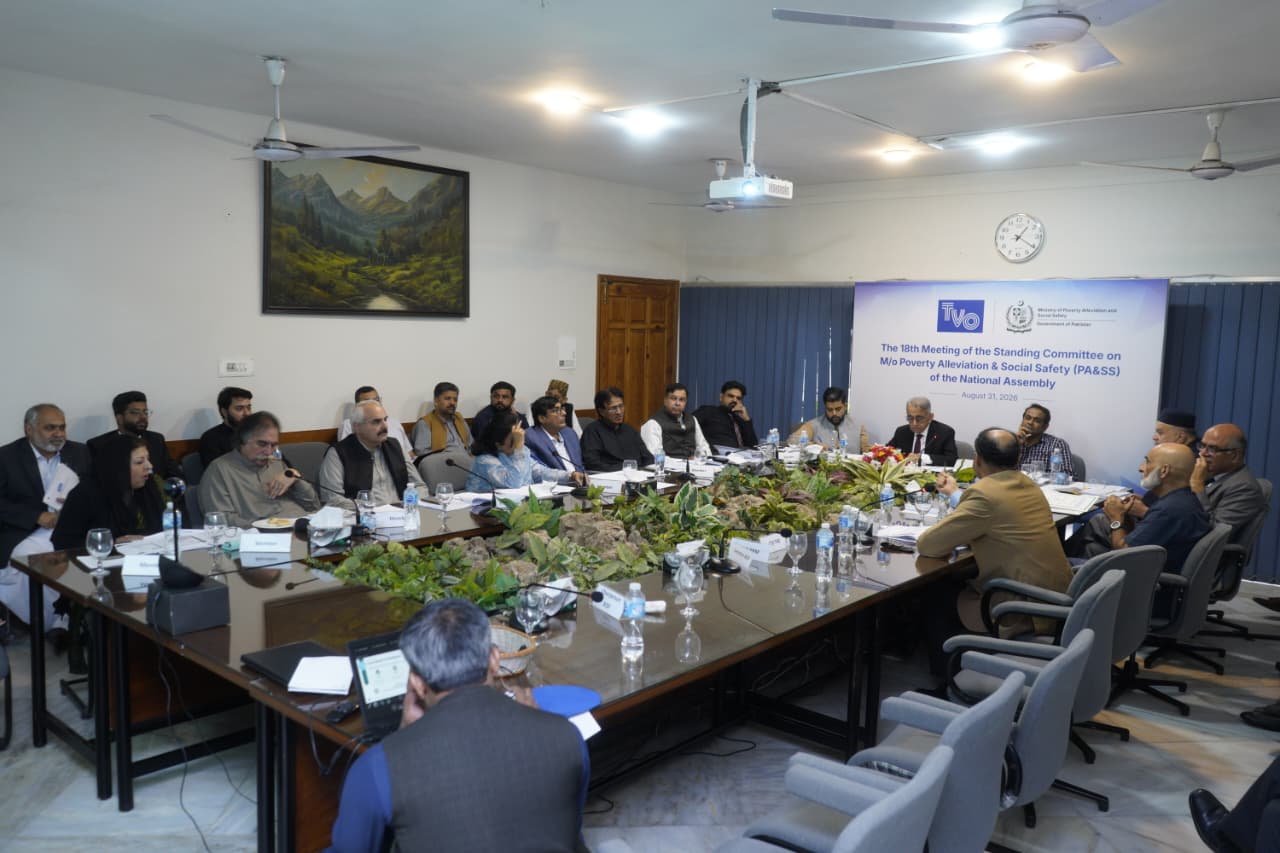
Islamabad, August 31, 2026: The Standing Committee on Poverty Alleviation and Social Safety held its 18th meeting today at 12:00 noon in the Committee Room of Trust for Voluntary Organization (TVO), 28 Ataturk Avenue, G-6/4 Islamabad under the Chairmanship of Mir Ghulam Ali Talpur. The meeting discussed a robust reaffirmation of the state's commitment to its most vulnerable citizens.
A significant portion of the session was dedicated to the Benazir Income Support Programme (BISP). The Committee, acceding to a request from the BISP Chairperson, deferred the implementation of its own recommendations from the 16th and 17th meetings pertaining to the BISP until its next sitting. The Chairman of the Standing Committee clarified that BISP had unnecessarily assumed the burden of addressing deductions in beneficiary funds by Point of Sale (POS) agents, a matter that squarely falls within the contractual obligations of its partner banks. He emphasized that BISP must focus on educating the masses regarding this procedural distinction and ensure Banks complies with their contractual obligations. The Chairman lauded the collective efforts of the Committee and the BISP management, which have culminated in the programme's successful digital transformation, marking a historic transition from in-person cash disbursements to a modern digital wallet system.
In a firm stance against potential policy shifts, the Chairman strongly advised against diverting BISP's social welfare funds towards public sector development programmes, warning that such a move would strip the underprivileged of their essential social safety net. He urged the government to preserve the BISP's integrity, even in its digitized form. The Minister for Poverty Alleviation and Social Safety (PASS), in turn, commended the Committee's proactive oversight. He outlined his ministry's strategic pivot towards skill development and stressed the urgent need for a National Poverty Alleviation Framework, coupled with a centralized data-sharing mechanism. Such a system, he argued, would ensure the efficient utilization of limited government and private relief agency resources, particularly during crises and natural disasters.
The Committee echoed these sentiments, emphasizing that social welfare and development remain the core objectives of its mandate, with the preservation of beneficiary self-respect as a paramount concern. While endorsing the tactical shift from social welfare to social development, the Committee offered its full support to the Ministry in taking concrete steps towards this transition. Concurrently, the Committee demanded robust action against banks found in violation of their contractual obligations and directed BISP to provide all its agreements with partner banks for review at the next meeting.
The Minister PASS clarified that neither BISP nor Pakistan Bait-ul-Mal disburses Zakat funds, and that all disbursements are sourced from endowment funds. He proposed expanding the number of beneficiaries by relaxing the criteria for the Proxy Means Test (PMT) score to maximize outreach. The Committee also identified a critical need for more diverse microfinancing options to provide sustainable support for small businesses.
The Committee vowed to formulate a definitive future course of action for BISP at its next meeting, with the BISP Chairperson in attendance. The Ministry Secretary informed members of ongoing work on skill development, in line with the Prime Minister's Office directives and in collaboration with the National Vocational & Technical Training Commission (NAVTTC). The Committee also resolved to consider establishing a sub-committee to address necessary legislative amendments to the BISP Act, ensuring that the legal framework supports its evolving strategic direction.
In its review of the Trust for Voluntary Organizations (TVO), the Committee received a comprehensive briefing from its Chief Executive Officer. The CEO TVO reported successfully executing 1,440 projects across rural Pakistan, benefiting over 10 million people at a total cost of Rs. 1.3 billion. The Committee was informed that the organization is funded by a Rs. 520 million endowment from the Pakistan-USA Special Development Fund (SDF) established in 1988, which is prudently invested in commercial bank funds as a passive yearly income-generating instrument. The TVO operates under a meticulous risk-sharing framework, with a 30:70 liability ratio between itself and its partner agencies, and adheres to a stringent vetting process for community-based organizations. This includes a mandatory two-year background check and a strict cap on administrative overheads, which must not exceed 15 percent to qualify for partnership.
The Committee commended the TVO for its strategic evolution from a relief-oriented entity to one focused on climate-resilient interventions, poverty graduation, and sustainable livelihoods, citing successful collaborations with international partners such as the International Fund for Agricultural Development (IFAD) and the National Poverty Graduation Programme (NPGP). These partnerships have resulted in tangible outcomes, benefiting 269 rural Tehsils across the country. In light of the recent exodus of international non-governmental organizations, the Committee observed that TVO has adeptly pivoted towards localized, sustainable solutions, ensuring continuity of essential services without imposing any financial liability on the government. Concluding its review with an unequivocal endorsement, the Committee strongly recommended that the government needs to ensure the TVO's continued and uninterrupted operation, acknowledging its remarkable contribution to uplifting rural populations and its invaluable role as a low-cost, high-impact partner in the national poverty alleviation agenda.
The Committee was attended by the following Members of the National Assembly: Mir Ghulam Ali Talpur, Mr. Ahmad Atteeq Anwer, Mr. Shahid Usman, Ms. Huma Akhtar Chughtai, Makhdoom Tahir Rashid Ud din, Mr. Mohammad Ilyas Choudhary, Mir Khan Muhammad Jamali, Nawabzada Iftikhar Ahmed Khan Babar and Ms. Saba Talpur. Meanwhile, Mr. Arshad Abdullah Vohra attended the meeting through the zoom link. Minister for Poverty Alleviation & Social Safety Mr. Imran Ahmed Shah, Managing Director Pakistan Bait ul Maal Senator Capt. Shaheen Khalid Butt, Secretary Ministry of Poverty Alleviation and Social Safety, Chairman TVO Board of Directors Mian Asad Hayauddin, Chief Executive Officer TVO Sahebzada Ghulam Mohyudin and senior officers from Ministry, TVO and BISP were also in attendance.
|

 Print
Print