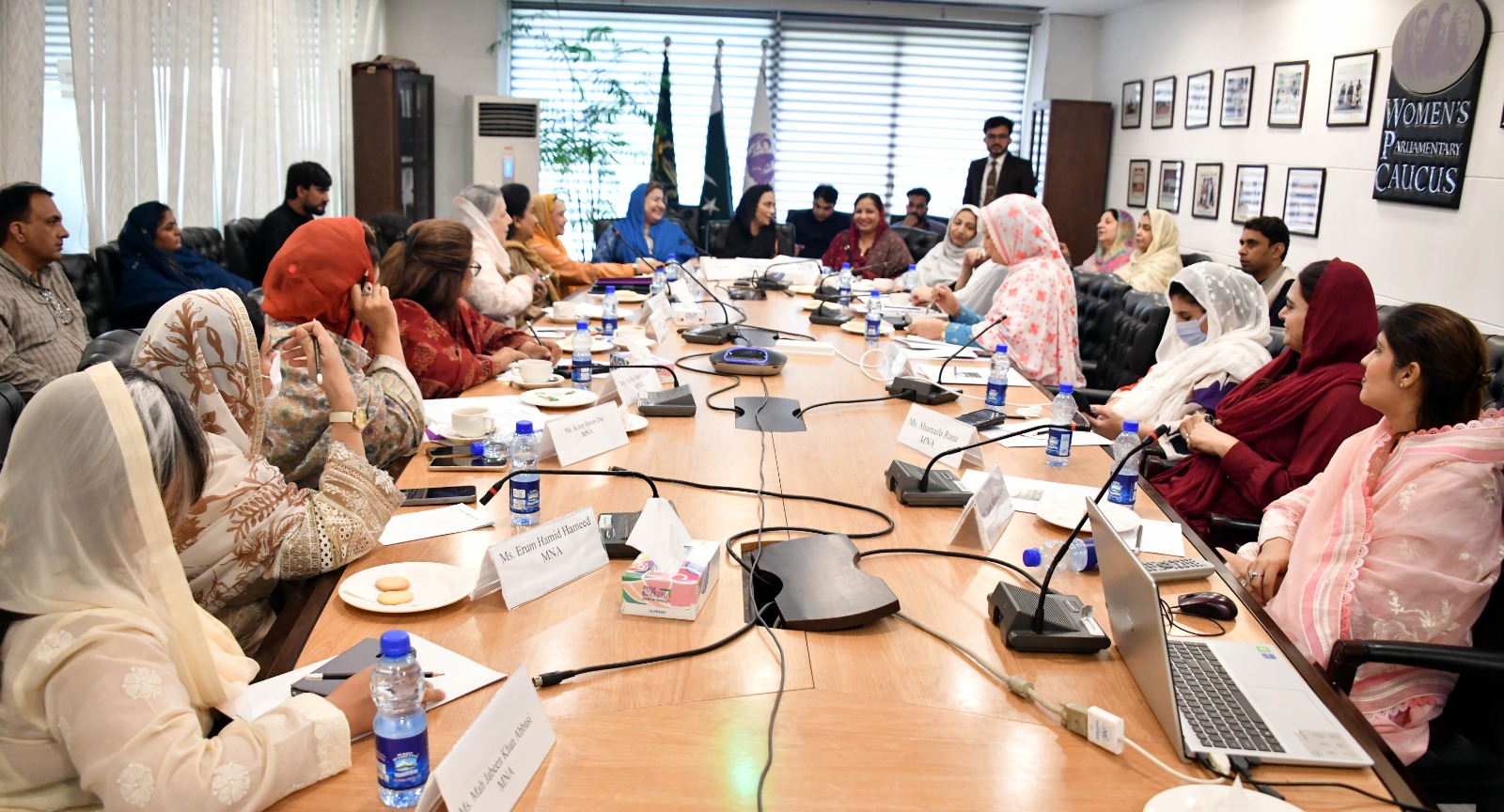
Islamabad, 18 August 2026: The 13th Meeting of the General Assembly of the Women’s Parliamentary Caucus (WPC) was held today at Parliament House, Islamabad, with a detailed briefing by the Ministry of Human Rights (MoHR) on the alarming rise in cases of honour killings, gender-based violence (GBV), femicide, and premeditated murders in Pakistan. The Ministry’s presentation specifically addressed the legal and policy framework concerning GBV and femicide and highlighted that there can be no justification for killing in the name of social or tribal prestige.
Secretary WPC, Dr. Shahida Rehmani, MNA, welcomed all participants and appreciated the Ministry of Human Rights for briefing the members on this important and sensitive issue. She also congratulated the Parliamentary Secretary for Human Rights Ms. Saba Sadiq, MNA, on the successful conduct of the 9th OIC Ministerial Conference on Women, hosted by Pakistan in Islamabad on 12–13 July 2026. The conference was organised in partnership with the OIC and the MoHR.
Dr. Shahida Rehmani appreciated the efforts of Ms. Saba Sadiq and other stakeholders in making the international conference a successful platform for dialogue, cooperation and exchange of experiences on women’s empowerment. The conference brought together ministers, senior officials and delegations from OIC Member States to strengthen collective efforts for women’s social, economic and political empowerment.
Members of WP appreciated the MoHR’s briefing and encouraged the Caucus to continue holding such thematic sessions on critical issues affecting women and girls. They stressed that regular briefings by relevant ministries and institutions are important for parliamentary oversight, legislative scrutiny and development of practical policy recommendations.
During the discussion, members expressed serious concern over the continued occurrence of killings committed under the pretext of “honour”. They called for a comprehensive review and scrutiny of the existing honour-killing laws to identify gaps in legislation, implementation, prosecution and protection mechanisms, and recommended appropriate reforms to make the legal framework more effective.
Members also suggested that the terminology “honour killing” should be reconsidered, as the term may inadvertently give an impression of legitimacy or justification to such crimes. They emphasised that there is no honour in killing a human being and that every such act must be treated as a serious criminal offence. MoHR’s presentation similarly highlighted the legal position that individuals cannot take the law into their own hands in the name of honour.
The members further called for stronger implementation of existing pro-women legislation, improved coordination among law-enforcement agencies and relevant institutions, and effective prosecution to ensure justice for victims and accountability of perpetrators.
The meeting also discussed the shortage of safe, affordable and accessible girls’ hostels, particularly for female students and working women coming from remote and underserved areas.
Members stressed that the lack of secure accommodation can restrict girls’ access to higher education, professional education and employment opportunities. They called for appropriate legislation and a comprehensive policy framework for the establishment, regulation and management of girls’ hostels.
The members proposed that the Government initiate public-private partnership (PPP) models for establishing new girls’ hostels and expanding existing facilities. They also called for the construction of new hostels in areas where demand is high and the renovation and upgradation of existing government hostels to provide safe, secure, hygienic and dignified accommodation to female students and working women.
The General Assembly also adopted a Resolution commemorating the 79th Independence Day of Pakistan and honouring the contributions of Pakistani women. The resolution paid tribute to the women who played an important role in the Pakistan Movement and to successive generations of Pakistani women who have contributed to the country’s political, social, economic, educational and professional development.
The resolution also acknowledged the sacrifices of the families of the Shuhada and Ghazis of Pakistan, particularly mothers, wives, daughters and sisters, and reaffirmed the importance of recognising the contribution of women to the defence, development and progress of the country. It called for continued efforts towards gender-responsive legislation, women’s meaningful participation in decision-making and greater opportunities for women and girls in education, skills development, technology, entrepreneurship and leadership.
WPC reaffirmed its commitment to advancing women’s rights through parliamentary dialogue, legislative scrutiny and policy advocacy and stressed that protection from violence, access to education, safe accommodation and meaningful participation in national development are essential for building a peaceful, prosperous and inclusive Pakistan.
The meeting was attended by Ms. Shahida Begum, MNA/Treasurer WPC; Ms. Saba Sadiq, MNA/Parliamentary Secretary for Human Rights; Ms. Rana Ansar, MNA; Ms. Tamkeen Akhtar Niazi, MNA; Ms. Zahra Wadood Fatemi, MNA; Ms. Sofia Saeed Shah, MNA; Ms. Kiran Imran Dar, MNA; Ms. Saira Afzal Tarar, MNA; Ms. Farah Naz Akbar, Parliamentary Secretary, Ministry of Federal Education and Professional Training; Ms. Erum Hamid, MNA; Ms. Ghazala Anjum, MNA; Ms. Shumaila Rana, MNA; Ms. Mahjabeen Abbasi, MNA; Ms. Zainab Baloch, MNA; Ms. Naeema Kishwar Khan, MNA; Ms. Neelam, MNA; Ms. Samina Khalid Ghurki, MNA; Ms. Mussarat Rafique Mahesar, MNA; Ms. Rabeea Hadi, Director General Human Resource; and Dr. Humera Jamal, Representative, National Commission on the Status of Women (NCSW).
 Print
Print