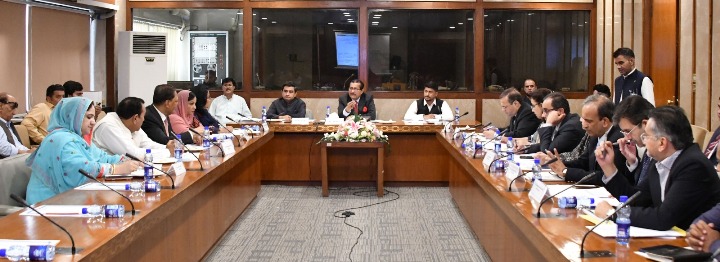
Islamabad, 08th July, 2026, A meeting of National Assembly Standing Committee on Economic Affairs Division was held under the Acting Chairmanship of Dr. Mirza Ikhtiar Baig, MNA at Committee Room No. 07, Parliament House, Islamabad.
The Standing Committee expressed deep concerns over the slow progress of the K-IV Water Supply Project, noting that only Rs. 10 billion had been allocated against the project's estimated requirement of Rs. 78 billion. The Committee observed that the significant funding gap could adversely affect the timely completion of the project and will delay the provision of an adequate water supply to Karachi. Emphasizing the strategic importance of the project, the Committee recommended that the Ministry of Water Resources and the Project Director for K-IV project to present a comprehensive briefing at its next meeting, covering the project's current status, financial requirements, implementation timeline, and the measures being taken to address existing constraints.
The Committee expressed reservations over the significant disparity in the estimated cost of the Lyari Elevated Freight Corridor (LEFC) Project under the proposed financing arrangement with the Korean Exim Bank compared to the estimate prepared by the National Highway Authority (NHA). The Committee observed that the proposed financing would entail a project cost nearly twice that estimated by the NHA and emphasized the need to identify the most cost-effective financing option in the national interest. Members were of the view that the Karachi Port Trust (KPT), being the principal beneficiary of the project, should actively explore viable financing mechanisms, including implementation through the Public-Private Partnership (PPP) mode. The Committee was informed that, under the proposed loan conditions, approximately 35 percent of the project materials and the contractor would be sourced from the Korea. After detailed deliberations, the Committee recommended that the Secretary, Economic Affairs Division, convene consultations with the National Highway Authority, the Ministry of Planning, Development and Special Initiatives, and the Karachi Port Trust to develop a mutually agreed and financially prudent financing model. The Committee further emphasized that all available options, including financing through the Public Sector Development Programme (PSDP), the Public-Private Partnership framework, or any other viable mechanism, should be comprehensively evaluated to ensure implementation of the project at the least possible cost and on terms more favourable than the proposed Korean Exim Bank financing.
The Committee was apprised of the progress on Tranche-III of the Central Asia Regional Economic Cooperation (CAREC) Project and was informed that, following nearly three years of litigation, the National Highway Authority (NHA) has awarded the contract for the project, with completion targeted by December 2027. While welcoming the resumption of the project, the Committee expressed concern over the substantial delays and emphasized the need for strict adherence to the agreed timeline. The Committee observed that approximately one and a half years remain for project completion and stressed that any further delay could have financial and implementation implications. It therefore recommended that, in the event the project is not completed within the stipulated timeframe, the Government should initiate timely negotiations with the financing partner to secure any extension of financing on the same terms and conditions, thereby safeguarding the national interest and ensuring the uninterrupted completion of the project.
The committee was briefed on International and Regional Economic Developments and their Implications for Pakistan's Economy. The Ministry of Economic Affairs informed that Pakistan entered 2026 with improving macroeconomic fundamentals, including stronger foreign exchange reserves, moderating inflation, and an improved sovereign credit rating. However, the outbreak of the Middle East conflict and the temporary closure of the Strait of Hormuz significantly disrupted global energy markets, resulting in higher oil prices, supply chain disruptions, and inflationary pressures.
The Ministry stated that Pakistan's weekly oil import bill increased from approximately US$300 million to US$800 million during the crisis, while inflation accelerated to 11.7 percent in May 2026. In response, the State Bank of Pakistan raised the policy rate by 100 basis points to 11.5 percent. The Ministry further highlighted that rising fuel and fertilizer prices, together with the possibility of reduced remittance inflows from Gulf countries, pose significant risks to Pakistan's external sector and overall economic stability.
The Ministry further informed that following the ceasefire and the Islamabad Memorandum of Understanding, international oil prices have moderated and maritime trade has largely resumed. Nevertheless, regional uncertainties persist, and any renewed escalation could adversely affect Pakistan's economy through higher energy costs, inflation, increased external financing needs, and slower economic growth.
Furthermore, the committee was briefed on Pakistan's participation in international and regional economic organizations. The Committee was informed that, EAD in accordance with its institutional mandate, serves as the Government's focal point for coordinating the operational activities of United Nations agencies, funds and programmes implemented under the United Nations Sustainable Development Cooperation Framework (UNSDCF) 2023–2027, while the Ministry of Foreign Affairs leads Pakistan's engagement with intergovernmental bodies such as the United Nations Economic and Social Council (ECOSOC) and the United Nations Economic and Social Commission for Asia and the Pacific (UNESCAP). Pakistan continues to actively participate in these organizations, contributing to global and regional policy dialogue on sustainable development, financing for development, climate action, trade facilitation, disaster risk reduction, digital transformation and regional connectivity. The committee was also informed that Pakistan remains a founding member of the Colombo Plan, through which it benefits from technical cooperation, human resource development and capacity-building programmes,
The meeting was attended by MNA’s including Dr. Mirza Ikhtair Baig, Mr. Muhammad Tufail, Mr. Muhammad Khan Daha, Ms. Saba Sadiq, Ms. Akhtar Bibi, Ms. Huma Chughtai, Mr. Muhammad Jawed Hanif Khan, Ms. Neelam and Ms. Zeb Jaffar (Parliamentary Secretary EAD). The meeting was also attended by Secretary EAD and officials of Ministry of Economic Affairs and other officers concerned.
 Print
Print