Syed Naveed Qamar Urges Tax Reforms that Promote Economic Growth Without Overburdening Honest Taxpayers-Finance Committee Finalizes Key Recommendations on Finance Bill 2026; Calls for Fair, Transparent, and Growth-Oriented Tax Reforms
Islamabad, 19 June 2026:The Standing Committee on Finance and Revenue, under the Chairmanship of Hon. Syed Naveed Qamar, MNA, continued its clause-by-clause consideration of the Finance Bill, 2026 during the sixth day of its 29th meeting, held at Parliament House, Islamabad.
The Committee undertook a comprehensive examination of the remaining provisions of the Finance Bill, 2026, receiving detailed briefings from the Ministry of Finance, the Federal Board of Revenue (FBR), and other relevant stakeholders. Deliberations focused on proposed amendments relating to taxpayer compliance, penalty mechanisms, the establishment of a Central Data Hub, sharing of banking transaction data with the FBR, algorithm-based cross-matching of financial information, faceless jurisdiction, and the engagement of experts for complex tax audits. The Committee conducted an extensive review of the legal, administrative, and technological dimensions of the proposed reforms, while carefully assessing their implications for taxpayers, businesses, and the overall economy.
During the deliberations, Hon. Chairman Syed Naveed Qamar emphasized that modernization of tax administration must strengthen transparency, efficiency, and voluntary compliance without compromising constitutional protections or imposing unnecessary hardships on law-abiding taxpayers. He observed that any centralized data-sharing framework should rest upon a sound legal foundation, supported by stringent confidentiality protocols, effective institutional oversight, and robust safeguards for the protection of taxpayers' privacy. The Chairman further underscored that technology-driven reforms should inspire public confidence in the tax system, facilitate compliance, and reinforce fairness rather than create apprehension among taxpayers.
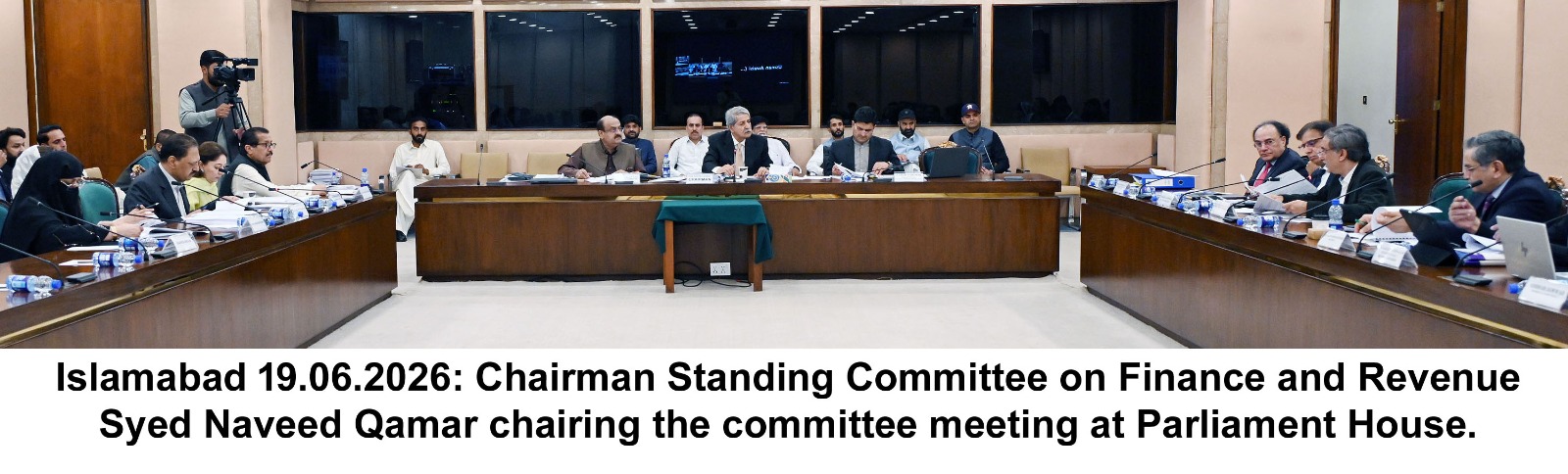
The Committee also examined the proposed amendments relating to penalties under tax laws, particularly the provisions concerning concealed income and assets. Hon. Members expressed concern that certain proposed penalties could disproportionately affect compliant and middle-income taxpayers and advocated a more balanced, risk-based enforcement framework. The Committee stressed that enforcement measures must remain fair, proportionate, transparent, and fully consistent with the principles of natural justice, while ensuring that deliberate tax evasion is effectively addressed through appropriate legal mechanisms.
The Committee further reviewed various taxation proposals with particular emphasis on their fiscal implications, implementation mechanisms, anticipated revenue outcomes, and likely impact on businesses, consumers, and the broader economy. Hon. Members emphasized that taxation measures should support economic stability, promote investment, broaden the tax base, and minimize compliance costs, particularly for small and medium enterprises. Members also highlighted the importance of protecting vulnerable segments of society and ensuring that fiscal measures do not contribute to an undue increase in the cost of living or adversely affect industrial competitiveness.
The Chairman reiterated that taxation policies must be equitable, transparent, predictable, and uniformly applicable across all sectors of the economy. He emphasized that sustainable revenue generation should primarily be achieved through expansion of the tax base rather than by placing additional burdens on existing taxpayers. Reaffirming the constitutional role of Parliament, he stressed that effective parliamentary oversight over significant taxation measures remains essential for ensuring transparency, accountability, and democratic governance.
The Committee appreciated the efforts of the Ministry of Finance and the Federal Board of Revenue for providing detailed technical briefings and directed the concerned authorities to incorporate the Committee's observations while finalizing the proposed legislative measures. It further emphasized that all reforms should be implemented in a phased, transparent, and consultative manner, supported by adequate institutional safeguards, effective monitoring mechanisms, and periodic reporting to Parliament.
Following extensive deliberations, the Committee finalized its recommendations on the matters considered during the meeting and directed the Secretariat to incorporate the approved recommendations into the Committee's Report on the Finance Bill, 2026, for presentation before the National Assembly.
The Committee decided to continue its consideration of the Finance Bill, 2026, at its next sitting scheduled to be held on Saturday, 20 June 2026, at 11:30 a.m.
The meeting was attended by Rana Iradat Sharif Khan, Mr. Ali Zahid, Syed Sami ul Hassan Gillani, Mr. Bilal Farooq Tarar, Mr. Muhammad Usman Awaisi, Ms. Zeb Jaffar, Dr. Nafisa Shah, Ms. Hina Rabbani Khar, Dr. Sharmila Faruqui, Dr. Mirza Ikhtiar Baig, Mr. Muhammad Javed Hanif Khan, Mr. Arshad Abdullah Vohra, and Ms. Shahida Begum, MNAs. The meeting was also attended by the Hon. Minister for Finance, the Minister of State for Finance, the Secretary Finance, the Secretary Aviation, the Director General (Tax Policy Office), Members of the Federal Board of Revenue, and senior officials from the Finance Division, the FBR, and other relevant Ministries and Divisions.

 Print
Print