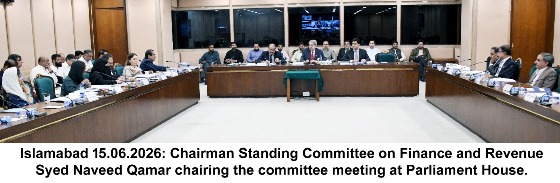
Islamabad, 15 June 2026:
Syed Naveed Qamar, Chairman expressed serious concerns regarding the potential revenue implications of the proposed concessions and the adequacy of efforts to broaden the tax base. The Chair sought clarity on whether the anticipated revenue losses had been adequately quantified and requested details of the Government’s strategy to offset any resulting fiscal shortfall.
He was chairing a meeting of the Standing Committee on Finance and Revenue was held today at Parliament House. The Committee received a comprehensive briefing from the Honourable Minister of State for Finance and senior officials of the Federal Board of Revenue (FBR) on the proposed tax measures, fiscal reforms, and revenue initiatives contained in the Federal Budget FY 2026–27.
The Committee also deliberated on relief for salaried individuals in the context of persistent inflation and rising living costs, and sought clarification on whether the proposed tax slab revisions would provide meaningful relief to middle-income groups. Concerns were further expressed regarding property tax reductions, incentives for the IT sector, and the effectiveness of such measures in promoting genuine investment, export growth, and economic sustainability rather than speculative activity.
While appreciating efforts to modernize tax administration, Hon. Members raised concerns regarding safeguards for taxpayer rights, transparency, due process, and data privacy under the proposed faceless audit and AI-driven assessment framework.
The Chairman observed that tax relief measures must remain equitable and economically justified, while stressing the need to broaden the tax base and improve compliance. He directed the Ministry of Finance and FBR to submit detailed revenue estimates, fiscal impact assessments, and implementation plans before further consideration of the Finance Bill, 2026.
The Committee was informed that the budget package comprises eleven relief measures, ten rationalization measures, and five administrative reforms aimed at promoting economic growth, encouraging investment, enhancing documentation of the economy, improving tax compliance, and strengthening revenue collection.
The briefing highlighted key relief measures, including the reduction of exporters’ minimum tax from 2% to 1.25%, continuation of the Final Tax Regime for IT exporters, relief for salaried individuals through revised tax slabs and abolition of surcharge, reduction in withholding taxes on property transactions, rationalization of Federal Excise Duty on international air travel, and reduction in super tax rates for certain categories of corporate taxpayers.
The Committee was informed that the relief package includes the abolition of taxes on contraceptives and selected women-related products, withdrawal of Capital Value Tax on foreign assets, exemption of sales tax for the shipping industry, and tax incentives for the modernization and upgrading of brownfield refineries. These measures are aimed at stimulating investment, promoting exports, supporting economic activity, and easing the overall tax burden on key sectors of the economy.
The Committee was also briefed on rationalization measures, including expansion of the Third Schedule, introduction of a fixed tax regime for small retailers, revision of tax treatment of coupon-washing transactions, elimination of tax arbitrage between industrial and commercial importers, enhancement of penalties for non-compliance, rationalization of withholding taxes on services, imposition of duties on luxury vehicles, and measures to curb fuel adulteration through adjustable Federal Excise Duty on solvents and related products.
Officials further apprised the Committee of administrative reforms, including the establishment of a National Faceless Audit Wing and National Assessment Wing, enhanced use of third-party data, algorithm-based dispute resolution, digital invoicing systems, and a Central Data Hub supported by artificial intelligence for risk assessment and compliance monitoring.
The Committee also approved the minutes of its previous meeting held on 13 June 2026.
The meeting was attended by Rana Iradat Sharif Khan, Ms. Zeb Jaffar, Dr. Nafisa Shah, Ms. Hina Rabbani Khar, Dr. Sharmila Faruqui, Dr. Mirza Ikhtiar Baig, Mr. Muhammad Javed Hanif Khan, and Ms. Shahida Begum, MNAs. The Honourable Minister of State for Finance and senior officers from the Ministry of Finance and Revenue and the Federal Board of Revenue also attended the meeting.

 Print
Print