Parliament Buildings
Pakistan’s parliamentary journey is deeply linked with the evolution of its iconic Parliament buildings, each symbolizing different chapters in the country’s political and constitutional history.
Old Sindh Legislative Assembly Building, Karachi (1947–1958)
The foundation stone of the Old Sindh Legislative Assembly Building was laid on March 11, 1940, by Sir Lancelot Graham, the then Governor of Sindh. Constructed over two years, the building was inaugurated on March 4, 1943. This historic venue became the very first Parliament of Pakistan—known as the Constituent Assembly—which held its inaugural session here on August 10, 1947.
.jpg)
It witnessed several momentous events, including the election of Quaid-i-Azam Muhammad Ali Jinnah as President of the Assembly and his oath-taking as Pakistan’s first Governor-General. The national flag was approved here, and the Objectives Resolution—later the cornerstone of Pakistan’s constitutional framework—was passed within its walls. The Transfer of Power ceremony, featuring Lord Mountbatten’s address to the Assembly on August 14, 1947, also took place at thissite. Furthermore, the first Constitution of Pakistan was adopted here on March 23, 1956.
.jpg)
In February 1961, following the relocation of the federal capital to Rawalpindi, parliamentary sessions moved to Ayub Hall, and the building reverted to serving as the Sindh Provincial Assembly.
Ayub Hall, Rawalpindi (1962- 1969)
During the regime of President Ayub Khan (1958–1969), Ayub Hall served as the center for parliamentary sessions and government affairs, reflecting the era’s centralized governance. While parliamentary sessions were held here, the hall gained particular significance as the platform where the Basic Democracies system was introduced, facilitating regional and local government elections. The Martial Law imposed in 1958 was revoked during a session in Ayub Hall, and the Constitution of 1962 was promulgated and implemented in this venue. The National Assembly began convening here under the 1962 Constitution, and in the lead-up to the 1970 General Elections, Ayub Hall functioned as a critical meeting point for political leaders and campaign activities. The building is now being used by a university for educational purpose.
.jpeg)
Provincial Assembly Chamber, Dacca1 (1963-1969)
Constructed in 1960s and designed by renowned architect Louis Kahn, the Provincial Assembly Chamber, Dacca also served as the seat of Pakistan’s National Assembly for East Pakistan from 1963 until 1969. During this period, Dacca was declared the second capital of Pakistan under Ayub Khan’s "One Unit" policy, aimed at addressing the political aspirations of East Pakistan. The building hosted legislative sessions that integrated East Pakistan more directly into the federal governance framework.
.jpeg)
Today, this building is used by the National Assembly of Bangladesh (Jatiya Sangsad), serving as a significant landmark.
.jpeg)
State Bank Building, Islamabad (1972-1986)
Following the independence of Bangladesh in 1971 and the subsequent shift of Pakistan’s capital to Islamabad, the State Bank Building was repurposed as the National Assembly’s seat. It was here that the Constitution of Pakistan, 1973 was adopted, replacing the interim Constitution of 1972 and establishing the federal parliamentary system in place today. Parliament remained suspended from 1977 to 1985 during General Zia-ul-Haq’s martial law. However, the National Assembly was revived in the same building following the non-party general elections held in 1985.
.jpeg)
On the occasion of the Golden Jubilee celebrations of the 1973 Constitution of the Islamic Republic of Pakistan, the old National Assembly Hall located in the State Bank Building, Islamabad, was officially declared a National Heritage site in 2023, recognizing its cultural and historic significance to Pakistan.
Parliament House, Islamabad (1986-Present)
The current Parliament House’s foundation stone was laid by the then Prime Minister Zulfiqar Ali Bhutto on August 14, 1974. Designed by American architect Edward Durell Stone, this majestic building was inaugurated on 29th May 1986 by President Zia-ul-Haq. Serving as the home of Pakistan’s National Assembly and Senate, the Parliament House has witnessed several landmark constitutional amendments, including the Eighth Amendment (1985), the Thirteenth Amendment (1997), the historic Eighteenth Amendment (2010) and the 25th Constitutional Amendment (2018). Today, it stands not only as the epicenter of Pakistan’s legislative process but also as a symbol of the nation’s democratic resilience and progress.
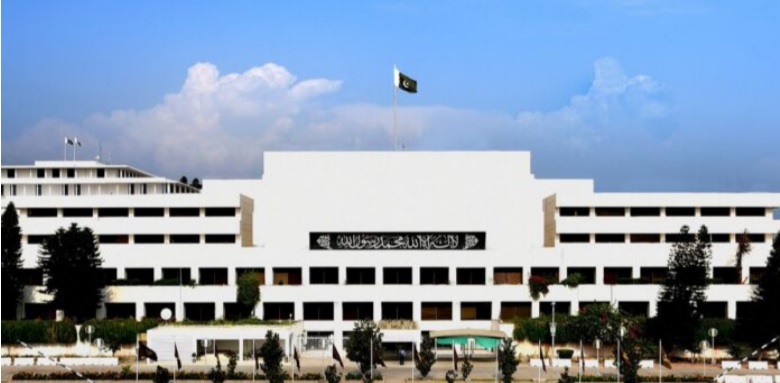
Parliament House Islamabad: A Symbol of Democracy and Architectural Grandeur
Inaugurated on 29th May 1986 after 11 years of meticulous construction, the Parliament House in Islamabad stands as a majestic landmark embodying both modern architectural innovation and rich Islamic heritage. Designed by the acclaimed American architect Edward Durell Stone, the building covers an impressive 598,000 square feet across five stories, harmoniously blending geometric precision with cultural symbolism. The design’s interplay of squares and circles creates a balanced, symmetrical layout, complemented by the alignment of the Cabinet Division, Parliament House, and President’s House, all nestled amid lush gardens and reflective water bodies that add a regal ambiance to the national capital.
At the heart of the complex lies the National Assembly Hall—an expansive oblong chamber crowned by a 130-foot diameter dome—with a seating capacity for 448 parliamentarians. Equipped with advanced electronic boards and a sophisticated public address system, the hall ensures seamless legislative proceedings while accommodating 822 visitors and a dedicated press gallery. The Parliament House further houses offices for key government officials, including the Prime Minister, Speaker, Leader of the Opposition, Chairman and Deputy Chairman Senate and Ministers, alongside committee rooms, libraries, and Services Centres, designed to foster collaboration and effective governance.
.jpg)
Architectural features such as four strategically placed light wells flood the interior with natural light, creating an open and inviting atmosphere. The terraced lawns facing the Presidency, along with trees planted by foreign dignitaries, enrich the exterior with diplomatic significance and historical depth. Practical amenities like a mosque, banking facility, dispensary, fire safety systems, and clearly marked emergency exits underscore the building’s functional excellence.
Beyond its architectural magnificence, the Parliament House is steeped in history and symbolism. The Gali-e-Dastoor, located on the first floor, pays tribute to Pakistan’s enduring struggle for constitutional democracy through an evocative mural divided into five historical segments.
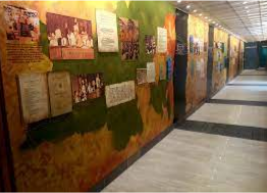
Nearby, the Yadgar-e-Dastur monument proudly commemorates the sanctity of the 1973 Constitution, with plaques inscribed with its Preamble and fundamental rights, framed by intricate Islamic motifs. The adjacent Bagh-e-Dastur features trees representing constitutional article, reinforcing the Parliament’s central role in governance and justice.
Honoring the sacrifices of countless political workers, intellectuals, journalists, and activists—the unsung heroes of Pakistan’s democracy—a dedicated monument on the Parliament lawns serves as a solemn reminder of their invaluable contributions. This site welcomes all visiting dignitaries who pay homage by laying wreaths, reaffirming the nation’s commitment to democratic values.
The Senate Museum, inaugurated in 2018, offers an immersive journey through the history and evolution of Pakistan’s upper house, showcasing life-size statues, detailed dioramas, and multilingual audio guides that bring past triumphs and challenges to life.
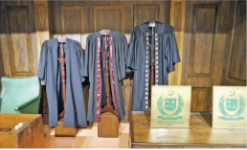
Historic treasures include the meticulously restored and re-displayed original portrait of Quaid-e-Azam Muhammad Ali Jinnah, relocated from the State Bank Building to the National Assembly Hall recently. Artistic treasures within Parliament feature masterpieces such as the renowned 1985 mural on unity by Ismail Gulgee, which highlights the cultural richness intertwined with the institution’s political legacy.
The Parliament House is more than just a building—it is the heart of Pakistan’s democracy, a space where history, architecture, governance, and culture converge to inspire a nation.
Pictures Courtesy: National Assembly’s Media Directorate
1 Assembly Debates, Volume III of 1963, dated 25th November, 1963.